Guide · 9 min read
How to build a habit that sticks
Most habits do not fail because people lack willpower. They fail because the plan asked for too much, the record was invisible, and one bad week felt like proof it was never going to work. Here is what the research actually says, and how to use it.
A 250-year-old habit tracker
In his twenties, Benjamin Franklin set out on what he called a "bold and arduous project of arriving at moral perfection." He listed thirteen virtues, from temperance to order to industry, and kept a small book with a page for each one. He ruled every page into seven columns, one for each day of the week, and marked a small black spot whenever he fell short.
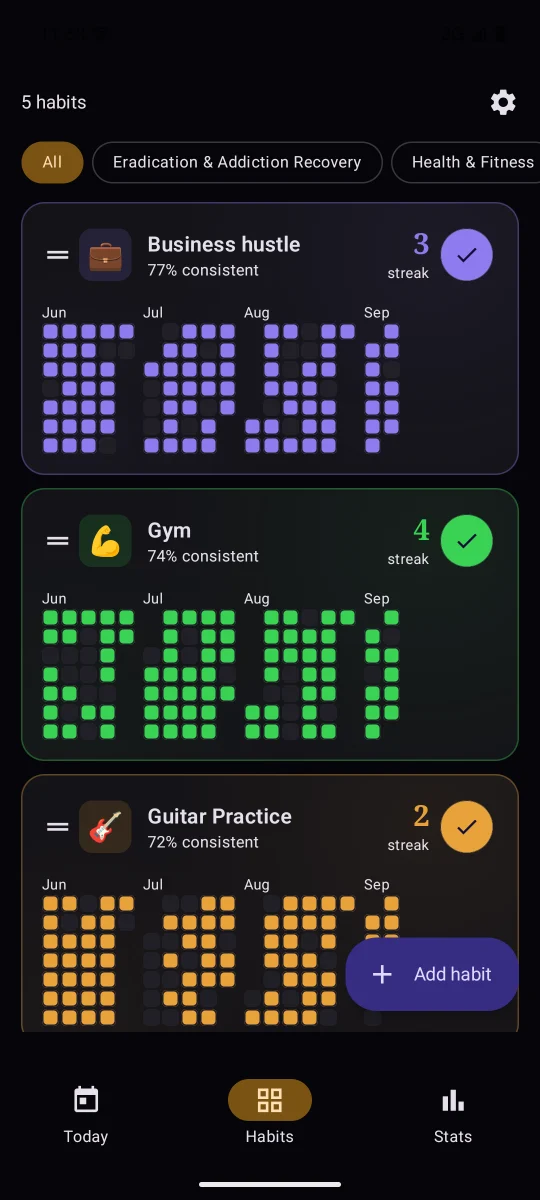
He did not try to fix everything at once. Each week he gave his full attention to a single virtue and simply kept the record for the rest, working through all thirteen in thirteen weeks and then starting again. It was, in every way that matters, a habit tracker: one row per habit, one square per day, and an honest mark when a day went wrong.
I was surprised to find myself so much fuller of faults than I had imagined; but I had the satisfaction of seeing them diminish.
Benjamin Franklin, The Autobiography
He never reached the perfection he was aiming for, and said so. But he wrote that the effort alone made him "a better and a happier man" than he would otherwise have been. That is the whole point of tracking a habit. Not a perfect page. A page that slowly gets fewer spots.
Habits are most of what you do
In 1890 the psychologist William James wrote that "all our life, so far as it has definite form, is but a mass of habits." A century later, researchers measured it. When Wendy Wood and her colleagues asked people to record what they were doing and thinking throughout the day, roughly 43% of everyday actions were performed almost automatically, often while the person was thinking about something else entirely.
That is the good news hiding in the research. You do not have to summon motivation for the rest of your life. You only have to repeat something in a stable context long enough that it stops needing a decision.
How long it really takes (not 21 days)
The popular "21 days" figure has no study behind it. The best-known real measurement comes from a study at University College London led by Benjamin Lally, published in 2010 in the European Journal of Social Psychology. Ninety-six volunteers chose one new daily behaviour, like drinking water with lunch or running before dinner, and rated how automatic it felt every day for twelve weeks.
- 66 days was the median time for a behaviour to reach its peak automaticity.
- 18 to 254 days was the range. Simple habits formed faster; harder ones took far longer.
- Missing a single day did not meaningfully set people back. The curve kept climbing.
If you are three weeks in and it still feels like effort, nothing is wrong with you. You are roughly a third of the way there.
Seven rules that actually hold up
-
Start smaller than feels useful
The early job of a habit is not to change your life. It is to exist every day. Two push-ups, one page, five minutes of practice. A small version you do beats an ambitious version you skip, and you can always do more on a good day.
-
Decide exactly when and where
In a 2002 exercise study by Sarah Milne, Sheina Orbell and Paschal Sheeran, people who only received motivational information exercised at rates of around 35 to 38%. People who also wrote down when and where they would exercise the following week did so at a rate of 91%. Write it as a sentence: "After I make coffee, I will read one page at the kitchen table."
-
Keep a record you can see
Franklin's little book worked because it was honest and visible. A record turns a vague feeling ("I have been slacking") into a fact you can act on ("I missed three Tuesdays"). It also gives you something rare: evidence that you are the kind of person who shows up.
-
Missing once is noise. Missing twice is a pattern.
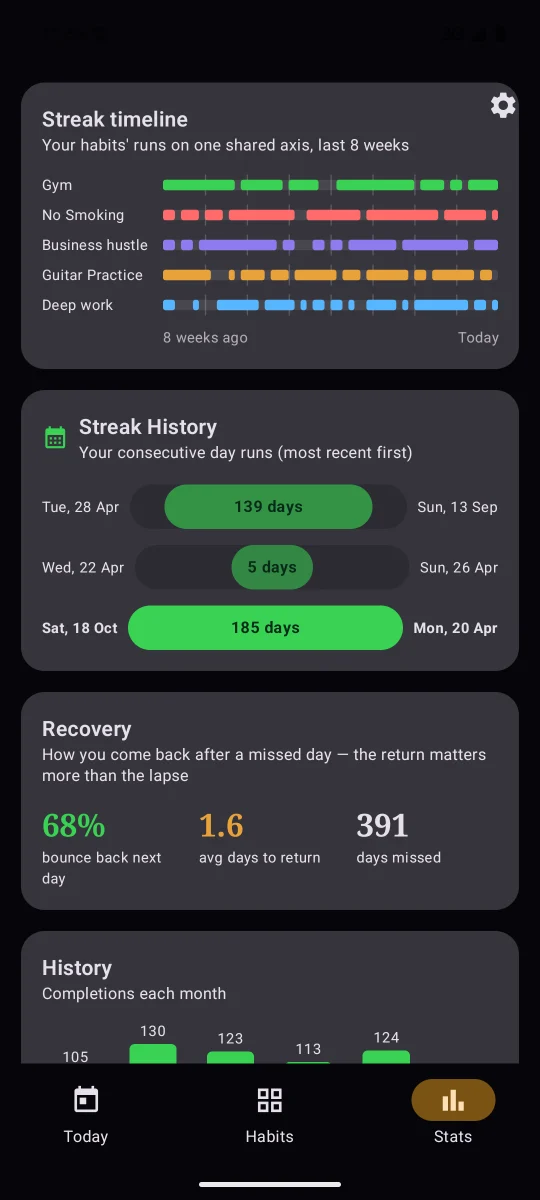
The UCL study found that a single missed day barely mattered. What matters is what you do next. Treat the day after a miss as the most important day in the whole habit, and get back to the smallest version of it.
-
Judge yourself on consistency, not streaks
A streak turns one bad day into a total loss, which is exactly the moment many people quit. Consistency over weeks is the truer measure: showing up on 80% of the days you planned is a habit forming, whatever happened last Thursday.
-
Use fresh starts on purpose
Researchers Hengchen Dai, Katherine Milkman and Jason Riis found that people are more likely to begin working towards goals after "temporal landmarks": a new week, a new month, a birthday. Gym visits rose after them. If a habit has drifted, do not wait for January. A Monday or the 1st of the month is a real, measurable reset.
-
Let go of the fruit
The Bhagavad Gita puts it in a single line that has outlived every productivity trend since. Your control ends at the action. The results arrive on their own schedule, and chasing them is how most people talk themselves out of the work on the days it matters most.
You have a right to your actions, but never to the fruits of your actions.
Bhagavad Gita 2.47
On the mornings it does not feel like it
Nearly two thousand years ago, a Roman emperor wrote himself a note for exactly those mornings. Marcus Aurelius had every reason to stay in bed and a great deal of work waiting for him. His answer was not motivation. It was identity.
In the morning when thou risest unwillingly, let this thought be present: I am rising to the work of a human being.
Marcus Aurelius, Meditations 5.1 (George Long translation)
The philosopher Will Durant, summarising Aristotle's ethics in 1926, put the same idea in a line that is now usually misattributed to Aristotle himself:
We are what we repeatedly do. Excellence, then, is not an act, but a habit.
Will Durant, The Story of Philosophy
A simple way to start this week
- Pick one habit. Write its smallest honest version.
- Write the sentence: After I ___, I will ___ at ___.
- Start on the next fresh start: tomorrow, Monday, or the 1st.
- Mark every day, including the misses. The record is the point.
- Check your consistency after four weeks, not your streak after four days.
Sources
- Franklin, B. The Autobiography of Benjamin Franklin, Part Two (the thirteen virtues and the daily record).
- James, W. (1890). The Principles of Psychology, Chapter IV, "Habit."
- Wood, W., Quinn, J. M., & Kashy, D. A. (2002). Habits in everyday life: Thought, emotion, and action. Journal of Personality and Social Psychology, 83(6), 1281–1297.
- Lally, B., van Jaarsveld, C. H. M., Potts, H. W. W., & Wardle, J. (2010). How are habits formed: Modelling habit formation in the real world. European Journal of Social Psychology, 40(6), 998–1009.
- Milne, S., Orbell, S., & Sheeran, P. (2002). Combining motivational and volitional interventions to promote exercise participation. British Journal of Health Psychology, 7(2), 163–184.
- Dai, H., Milkman, K. L., & Riis, J. (2014). The fresh start effect: Temporal landmarks motivate aspirational behavior. Management Science, 60(10), 2563–2582.
- Bhagavad Gita, Chapter 2, Verse 47.
- Marcus Aurelius. Meditations, Book 5, §1, trans. George Long.
- Durant, W. (1926). The Story of Philosophy, chapter on Aristotle.